
NexaVision AI: from loose automations to an AI product for SMBs
How I am shaping NexaVision AI as an AI automation product for SMBs: support, leads, internal processes, content, n8n and LLMs.
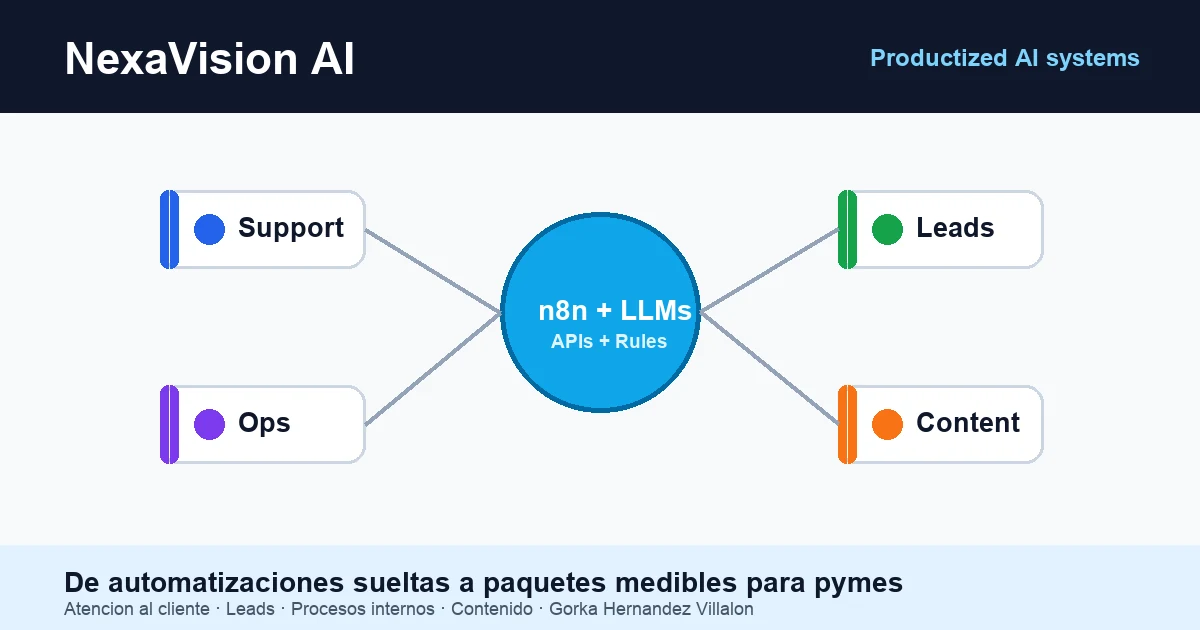
After reviewing the public NexaVision AI website, its services and solutions pages, and the articles I had already written in this portfolio, I do not think the next useful article is another basic explanation of "what NexaVision is". I already covered that in NexaVision AI: what I am building and why it is one of my most important projects and in the AI systems I have built for NexaVision AI.
The more useful question now is:
How do you turn a collection of AI automations into a serious,
repeatable and measurable product for small and medium-sized businesses?
That is the real challenge. An AI demo can impress for five minutes. An AI system for business has to live for weeks, months and years inside real processes: customers, bookings, leads, invoices, emails, calendars, social media, content, data and people.
Direct answer
NexaVision AI is a company co-founded by Roger Pumarola and me, focused on turning operational chaos into intelligent systems for businesses. The public website presents four main lines: customer support, lead capture and management, internal process automation and social media content generation.
My technical read is that NexaVision AI should evolve from "we build automations" into "we deploy measurable AI packages for concrete processes".
| Line | Problem it solves | Possible product |
|---|---|---|
| Customer support | Repetitive questions, waiting times and overloaded teams | Web, WhatsApp or email agent with human escalation |
| Leads | Difficulty capturing, qualifying and following opportunities | Lead capture, scoring and commercial follow-up engine |
| Internal processes | Invoices, bookings, KPIs, documents and repetitive tasks | Operational copilot connected to real tools |
| Content | Lack of consistency and time to publish | AI-assisted editorial system with human review |
| Bookings | Conversations that must become reliable actions | Booking agent with calendar, validation and confirmation |
The key is not selling "AI". The key is selling less operational friction, more traceability and more time for the tasks that really need human judgement.
What I researched before writing
The NexaVision AI website positions the company around a clear idea: moving from operational chaos to efficient processes with artificial intelligence. The homepage lists services such as customer support, lead capture, social media, internal processes, automated blogs and advertising videos.
The solutions page organizes business pain points quite directly:
- teams saturated by answering the same questions again and again;
- lack of consistent lead generation;
- hours lost in repetitive internal tasks;
- difficulty keeping professional social content consistent.
I also reviewed the current direction of n8n for AI automation. Its message fits well with what I am trying to build: combine AI with explicit logic, human approvals, business rules, traceability and monitoring. In other words, do not let the model decide everything; put it inside a controllable workflow.
This confirms an intuition I see more clearly every month: for SMBs, the opportunity is not selling "a chatbot". It is giving them systems that connect the tools they already use.
The mistake: selling automations as isolated pieces
An isolated automation can work, but it is harder to maintain and sell.
For example:
- a workflow that answers emails;
- another one that generates posts;
- another one that finds leads;
- another one that stores invoices;
- another one that screens CVs;
- another one that creates bookings.
If each piece is sold as something completely different, every project starts from scratch. That uses time, complicates support and keeps technical knowledge scattered.
The natural evolution is turning those systems into packages:
| Loose automation | More scalable product |
|---|---|
| Answer an email with AI | Support agent by channel with knowledge base and escalation |
| Lead scraper | Sales pipeline with capture, enrichment, scoring and follow-up |
| Automatic post | Editorial engine with calendar, brand voice and approval |
| Invoice workflow | Internal classification, archiving and reporting system |
| WhatsApp booking | Booking assistant with validation, calendar and cancellations |
That shift looks small, but it changes everything. A package has a clear promise, limits, pricing, deliverables, configuration, maintenance and a success metric.
Package 1: customer support agent
The public NexaVision AI website highlights customer support across web, WhatsApp and email. That makes sense because it is one of the easiest use cases for an SMB to understand: if the team answers the same thing many times, there is friction.
But a good customer support agent should not only be a chat that sounds nice.
It should have:
- updated knowledge base;
- brand tone;
- intent detection;
- answers grounded in internal sources;
- human escalation;
- conversation logging;
- analytics for repeated questions;
- clear boundaries around what it cannot promise.
This connects with what I wrote in AI agents for customer service and retail. The goal is not replacing the team. It is removing repetitive volume and making important questions arrive with more context.
Package 2: lead capture and management
Lead capture is another natural block for NexaVision AI. Many companies do not have a "no market" problem; they have an organization problem: scattered data, unprioritized lists, contacts without follow-up and little commercial consistency.
A good lead system should do several things:
- Find opportunities.
- Enrich data.
- Classify by sector, location, size or likely need.
- Score fit.
- Generate initial messages.
- Record status.
- Notify when follow-up is needed.
This connects with my experience building scraping, normalization and scoring systems, both inside NexaVision AI and in the project where I found internships by automating LinkedIn job discovery. The core idea is the same: move from a huge list to an actionable queue.
AI does not replace the salesperson. It reduces noise.
Package 3: internal processes
Internal processes are where hidden value can be strongest. They are not always as visible as a chatbot, but they often touch tasks that consume time every week:
- invoices;
- bookings;
- reports;
- KPIs;
- documents;
- internal emails;
- forms;
- CV screening;
- file organization;
- alerts and reminders.
In these cases, the AI model should not be the centre. The process is the centre.
For example, in the restaurant booking system with AI, WhatsApp and n8n, AI interprets the message, but the important rules are deterministic: opening hours, capacity, required fields, calendar, confirmation and cancellation.
That separation is fundamental. AI interprets. Rules protect the operation.
Package 4: content and digital presence
NexaVision AI also offers social media content generation, automated blogs and advertising videos. This block has potential, but also a risk: mass-producing content without judgement.
I would frame it as an AI-assisted editorial system, not an uncontrolled autopublisher.
A healthy system should include:
- editorial calendar;
- brand tone;
- clear sources or inputs;
- draft generation;
- channel adaptation;
- human review;
- scheduled publishing;
- performance measurement;
- reuse of content that already worked.
AI can accelerate content creation massively, but the brand still needs judgement. Especially when publishing on behalf of a real company.
The architecture behind it
For NexaVision AI to scale, having many workflows is not enough. It needs a repeatable technical foundation.
The architecture that best fits what I have been building is:
| Layer | Function |
|---|---|
| Input | WhatsApp, web, email, forms, Telegram, RSS, calls or webhooks |
| Orchestration | n8n as the visual and traceable workflow layer |
| AI | LLMs to classify, summarize, write, extract or decide next steps |
| Code | JavaScript, Python, FastAPI or external services for critical logic |
| Data | Sheets, CRM, databases, Calendar, Drive or client APIs |
| Control | validations, permissions, human-in-the-loop and fallback |
| Observability | logs, versions, errors, cost, latency and metrics |
This approach is aligned with what n8n itself emphasizes: AI combined with explicit logic, human approvals, monitoring and traceability.
It is also what I have explained in multi-tenant architecture with n8n and AI agents and AI agent observability in production.
How I would measure whether it works
An AI automation should not be sold only because "it looks modern". It should be measured.
For each NexaVision AI package, I would define a primary metric:
| Product | Main metric |
|---|---|
| Support agent | Percentage of repetitive requests solved without escalation |
| Leads | Qualified opportunities per week |
| Internal processes | Manual hours saved per month |
| Content | Approved publications and channel performance |
| Bookings | Correctly created bookings and avoided errors |
And several technical metrics:
- cost per execution;
- latency;
- error rate;
- human escalation percentage;
- completed tasks;
- unresolved cases;
- tokens per workflow;
- prompt and model version used.
Without measurement, AI becomes opinion. With measurement, it becomes product.
What I would not automate
It is also important to say that not everything should be automated.
I would not automate by default:
- delicate legal decisions;
- answers that imply financial commitments without validation;
- sensitive data processing without a clear framework;
- irreversible actions;
- public content without initial review;
- communications where brand reputation is at stake.
A good AI product is not the one that removes all humans. It is the one that knows where a human should appear.
Conclusion
The opportunity for NexaVision AI is not only building workflows. It is turning those workflows into clear, repeatable and measurable systems.
My approach would be:
- Define packages around real problems.
- Build a maintainable multi-tenant n8n foundation.
- Separate AI, rules, data and actions.
- Measure savings, quality and conversion.
- Keep human escalation where risk exists.
- Document every delivery so the client understands what they have.
NexaVision AI can position itself very well if it avoids the trap of "AI for everything" and focuses on something more concrete: AI automation systems for companies that want to operate better without complicating their stack.
For me, that is the project's strongest point. Not selling magic. Building practical infrastructure.