
AI model ranking in July 2026: value for money and China's rise
A practical July 2026 ranking of AI models: GPT, Claude, Gemini, DeepSeek, Qwen, Kimi, GLM and MiniMax by value for money.
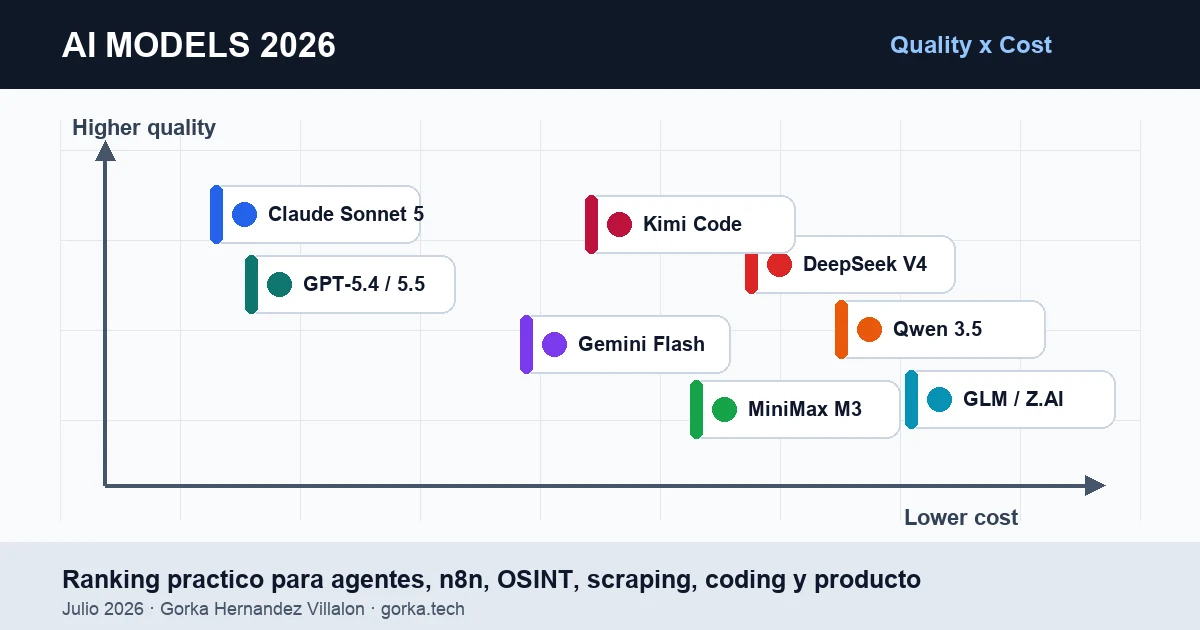
The question "which AI model is best?" matters less every month unless it comes with another question: best for what, and at what price? In July 2026, the market is no longer only about two or three frontier models. The premium layer is still strong, but the pressure from below is huge: DeepSeek, Qwen, Kimi, GLM/Z.AI and MiniMax are pushing token costs to levels that looked unrealistic only a couple of years ago.
This ranking is not meant to be a scientific benchmark. It is a practical read for the kind of projects I build: agents, n8n workflows, OSINT with web search, scraping, dashboards, process automation, coding and LLM-powered products. I used official pricing pages where available and an independent reference such as Artificial Analysis, which compares models by quality, price, speed, latency and context window.
Important: prices move quickly. This is a reasoned snapshot as of July 8, 2026. I am not including models without a stable public pricing page, even if there are nearby announcements or rumours.
Direct answer
My practical value-for-money ranking for July 2026 is:
| Rank | Model or family | Why it makes the ranking |
|---|---|---|
| 1 | DeepSeek V4 Pro / Flash | Extremely low cost, 1M context, thinking mode, tool calls and compatible API |
| 2 | Qwen 3.5 | Very strong pricing, open ecosystem and global deployment through Alibaba Cloud |
| 3 | Claude Sonnet 5 | Best premium balance for reasoning, writing, coding and agents |
| 4 | MiniMax M3 | Aggressive long-context pricing, interesting for agents and large documents |
| 5 | Gemini Flash / Flash-Lite | Strong ecosystem, multimodality and Google grounding |
| 6 | GPT-5.4 / GPT-5.4-mini / GPT-5.5 | Ecosystem, reliability and tooling, although not the cheapest |
| 7 | GLM-5 / GLM-4.7 / GLM FlashX | Chinese provider with very low prices, integrated tools and strong potential |
| 8 | Kimi K2.7 Code / K2.6 | Very interesting for coding, long context and multimodal agents |
If I had to build a real architecture, I would not use one model for everything. I would use a router: cheap models for classification and data cleaning, strong Chinese models for volume, and a premium model as fallback for high-risk tasks.
The pricing table that explains the shift
The prices below are per 1M input and output tokens, in USD, based on official pages checked in July 2026.
| Model | Input | Output | Quick read |
|---|---|---|---|
| DeepSeek V4 Flash | $0.14 | $0.28 | Excellent for volume, classification and repeatable tasks |
| DeepSeek V4 Pro | $0.435 | $0.87 | Very strong value for agents and reasoning |
| Qwen3.5 397B A17B | $0.172 | $1.032 | Very aggressive price for a large model |
| Qwen3.5 122B A10B | $0.115 | $0.917 | Good production balance with controlled cost |
| Qwen3.5 35B A3B | $0.057 | $0.459 | Ideal for volume and less critical tasks |
| MiniMax M3 | $0.30 | $1.20 | Cheap long context up to 512k tokens |
| GLM-5 | $1.00 | $3.20 | General Chinese alternative with good pricing |
| GLM-4.7 FlashX | $0.07 | $0.40 | Very cheap for simple automations |
| Gemini 3.1 Flash-Lite | $0.25 | $1.50 | Good for high-volume agentic tasks and multimodality |
| Claude Sonnet 5 | $2.00 | $10.00 | Promotional price through August 31, 2026 |
| GPT-5.4 mini | $0.75 | $4.50 | Low-cost option inside the OpenAI ecosystem |
| GPT-5.4 | $2.50 | $15.00 | Strong general model, more expensive than Chinese alternatives |
| GPT-5.5 | $5.00 | $30.00 | Frontier general model, but the cost must be justified |
The conclusion is clear: the pricing gap is no longer 20%. In some cases, using a Chinese model for repeatable tasks can be ten, twenty or more times cheaper than using a premium frontier model for everything.
1. DeepSeek: the pricing shock that is hard to ignore
DeepSeek is the first provider I would test if the project allows a Chinese provider and there are no strict privacy, compliance or data residency constraints.
According to its
official models and pricing page, DeepSeek V4
offers two main variants: deepseek-v4-flash and deepseek-v4-pro. Both have 1M context, thinking
mode, JSON output and tool calls. V4 Flash costs $0.14 per 1M input tokens and $0.28 per 1M output
tokens. V4 Pro costs $0.435 and $0.87.
For an n8n workflow, that changes the economics:
- classify leads;
- clean scraping data;
- summarize non-sensitive internal documents;
- draft outputs;
- extract structured fields;
- run initial scoring;
- decide whether a task deserves a more expensive model.
My read: DeepSeek V4 Pro is probably the number one value-for-money model if you can use it without legal or security issues. I would not automatically choose it for regulated banking, healthcare or highly confidential data, but for volume and experimentation it is hard to beat.
2. Qwen: the Chinese ecosystem that looks most like a platform
Qwen, from Alibaba, is gaining momentum for three reasons: good pricing, model variety and an open ecosystem. It is not just "another cheap Chinese model". It is a broad family with general, coder, vision, thinking and internationally deployed models.
In the Alibaba Cloud Model Studio documentation, the Qwen3.5 family appears with very aggressive global pricing. For example, Qwen3.5 397B A17B is listed in global regions at $0.172 per 1M input tokens and $1.032 per 1M output tokens up to 128K tokens. Qwen3.5 35B A3B drops to $0.057 and $0.459.
This makes it interesting for:
- high-volume support chatbots;
- document scoring;
- feedback analysis;
- multilingual tasks;
- low-margin internal workflows;
- agents that need many small calls;
- pipelines where token cost matters more than the last 3% of quality.
My read: Qwen is the Chinese platform I would watch most closely. DeepSeek may win on media impact and extreme pricing, but Qwen looks like a very serious piece for real products.
3. Claude Sonnet 5: the premium model that still makes sense
Claude Sonnet 5 is not the cheapest model, but it remains one of the best balances when a task requires high quality: long-form writing, reasoning, code, requirements analysis, technical documentation and agents with complex instructions.
Anthropic lists Claude Sonnet 5 at $2 per 1M input tokens and $10 per 1M output tokens through August 31, 2026. It then moves to $3 and $15. That promotion puts it in a very competitive place against other premium models.
I would use it for:
- reviewing workflow architecture;
- writing important technical documentation;
- analyzing ambiguous requirements;
- coding with large context;
- evaluating other model outputs;
- acting as fallback when the cheaper model is uncertain.
My read: Claude Sonnet 5 is the best premium value-for-money model in July 2026. It is not the model for processing millions of cheap rows, but it is strong where mistakes cost more than tokens.
4. MiniMax M3: cheap long context with an agentic focus
MiniMax M3 is another Chinese model worth serious attention. Its pitch is not only price, but long context and agentic work. In its official pricing page, MiniMax M3 is listed at $0.30 per 1M input tokens and $1.20 per 1M output tokens up to 512K tokens; above 512K it moves to $0.60 and $2.40.
This is interesting for workflows that need to read a lot:
- contracts;
- customer history;
- long documentation;
- repositories;
- large PDFs;
- log analysis;
- comparison of many sources;
- agents that carry operational context.
My read: MiniMax M3 may not always win as a general chatbot, but it can be one of the best choices when long context is central to the problem. For OSINT or document analysis, I would test it.
5. Gemini: when you need multimodality, grounding and the Google ecosystem
Gemini does not always win the raw pricing ranking, but Google has a clear advantage: search integration, multimodality, audio, video, maps, AI Studio and Google Cloud.
In the official Gemini API pricing page, Google positions Gemini 3.1 Flash-Lite as an efficient model for high-volume agentic tasks, translation and simple data processing. The listed price is $0.25 per 1M input tokens and $1.50 per 1M output tokens. Many Gemini models also include options for grounding with Google Search and Maps, which matters for tasks connected to external information.
I would use it for:
- multimodal tasks;
- image/video analysis;
- prototypes with Google AI Studio;
- agents with web grounding;
- products built on Google Cloud;
- workflows where search and model integration matter.
My read: Gemini is one of the strongest ecosystem plays. If the project lives on Google Cloud or depends heavily on search, its value is not only measured in tokens.
6. OpenAI: not the cheapest, still the product standard
OpenAI does not win the raw cost ranking. In its official pricing page, GPT-5.4 mini is listed at $0.75 input and $4.50 output, GPT-5.4 at $2.50 and $15, and GPT-5.5 at $5 and $30 under standard short-context pricing.
So why still use it? Ecosystem:
- tooling;
- API stability;
- documentation;
- integrations;
- enterprise adoption;
- specialized models;
- product-building speed;
- high general quality;
- compatibility with existing stacks.
My read: OpenAI remains a very safe product bet, but it should no longer be used automatically for everything. In 2026, combining OpenAI with cheaper models makes a lot of sense.
Practical example:
| Task | Possible model |
|---|---|
| Initial classification | DeepSeek V4 Flash, GLM FlashX, Qwen 35B |
| Structured extraction | DeepSeek V4 Pro, Qwen 122B, Gemini Flash |
| Important final writing | Claude Sonnet 5, GPT-5.4, GPT-5.5 |
| Evaluation or audit | Claude Sonnet 5, GPT-5.4, DeepSeek V4 Pro |
| Critical fallback | GPT-5.5 or premium Claude |
7. GLM/Z.AI: cheap, fast to test and tool-friendly
Z.AI, associated with GLM/Zhipu, has a pricing table that stands out. In its official documentation, GLM-5 is listed at $1 input and $3.20 output; GLM-4.7 at $0.60 and $2.20; GLM-4.7 FlashX at $0.07 and $0.40. It also lists web search as an integrated tool at $0.01 per use.
That makes it attractive for:
- prototypes;
- agents with web search;
- low-budget workflows;
- comparison experiments;
- classification and summarization;
- internal tools that need low costs.
My read: GLM/Z.AI is one of the underrated names in the ranking. It may not have the global brand of OpenAI or Anthropic, but the pricing and tooling justify testing it.
8. Kimi: the Chinese model I would watch for coding
Kimi, from Moonshot AI, is especially interesting for coding and long-context agents. The documentation for Kimi K2.7 Code describes it as Kimi's strongest coding model, with multimodal input, thinking modes, agent tasks and 256K context. Kimi K2.6 is also described as a multimodal model with tool calls, JSON mode, partial mode and internet search.
My read: Kimi is one of the most relevant Chinese models for programming and technical agents. If you work with large repositories, code generation or agentic IDE-style tools, Kimi belongs on the radar.
I would not place it first overall because the official price is not always as easy to compare as DeepSeek, Qwen or MiniMax, but the technical positioning is very strong.
Ranking by use case
The best way to choose a model is to separate use cases.
| Use case | My main pick | Alternatives |
|---|---|---|
| Cheap volume | DeepSeek V4 Flash | GLM FlashX, Qwen 35B |
| General value | DeepSeek V4 Pro | Qwen 397B, Gemini Flash |
| Serious coding | Claude Sonnet 5 | Kimi K2.7 Code, GPT-5.4 |
| Long context | MiniMax M3 | Kimi K2.6, DeepSeek V4, Qwen |
| Enterprise product | OpenAI / Anthropic / Google | Depends on compliance and region |
| Multimodality | Gemini | Kimi, MiniMax, GPT depending on task |
| Web search / grounding | Gemini | GLM/Z.AI, OpenAI/Anthropic with tools |
| n8n workflows | DeepSeek + Claude/GPT fallback | Qwen + Gemini fallback |
| Sensitive data | Enterprise provider or self-host | Avoid sending critical data without a DPA |
Why Chinese models are gaining so much momentum
China is competing with a different strategy from many Western providers:
- aggressive pricing;
- efficient MoE models;
- broad open-weight or semi-open availability;
- developer focus;
- long context;
- APIs compatible with existing formats;
- full model families, not a single model;
- fast iteration;
- strong push in coding and agents.
This resembles what has happened in other industries: the absolute best product does not always win; the product with an impossible-to-ignore performance-to-price ratio often does.
For a company, the question is no longer:
Which model is the smartest?
The real question is:
Which combination of models solves my process with enough quality,
controlled cost, traceability and acceptable risk?
The uncomfortable part: privacy, compliance and dependency
A cheap model is not automatically the right model. Real projects need to check:
- where data is processed;
- whether data is retained;
- whether inputs are used for training;
- available regions;
- contract and DPA;
- auditability;
- logs;
- encryption;
- access control;
- deletion capabilities;
- political or regulatory risk.
In a portfolio, prototype or public scraping project, you can experiment more. In banking, healthcare, insurance, HR or personal data, the ranking changes. In those cases, paying more for an enterprise provider, data residency or private deployment can be worth it.
The rule I would use is simple:
| Data type | Strategy |
|---|---|
| Public or synthetic | You can test cheap models |
| Internal but not sensitive | Router with logs and limits |
| Personal or regulated | Enterprise provider, DPA and controlled region |
| Highly sensitive | Self-host, private cloud or do not send to an LLM |
How I would apply this in my own systems
If I had to build an automation system with n8n, FastAPI or Spring today, I would use this architecture:
- Cheap preprocessing model: DeepSeek V4 Flash, GLM FlashX or Qwen 35B.
- Mid-tier reasoning model: DeepSeek V4 Pro, Qwen 397B, Gemini Flash or MiniMax M3.
- Premium model for important decisions: Claude Sonnet 5, GPT-5.4 or GPT-5.5.
- Separate evaluator: another model reviews the output before a sensitive action.
- Risk-based fallback: if confidence is low, escalate to a human or premium model.
- Cost logging: each call stores model, tokens, latency, error and outcome.
- Own evaluations: do not rely only on external benchmarks.
This connects with what I have written about AI agent observability, pre-production evaluation and reliable AI automations. The model matters, but the architecture matters more.
My conclusion
In July 2026, the real ranking is not just "OpenAI vs Anthropic vs Google". That fight still exists, but the most interesting part is cost.
My final read:
- best general value: DeepSeek V4 Pro;
- best balanced premium model: Claude Sonnet 5;
- best Western ecosystem: OpenAI and Google, depending on the product;
- Chinese platform to watch: Qwen;
- Chinese long-context bet: MiniMax M3;
- Chinese coding bet: Kimi K2.7 Code;
- cheap underrated option: GLM/Z.AI;
- best real strategy: model routing, not choosing only one.
The advantage is no longer using "the most expensive model". The advantage is knowing how to design a system that uses each model where it creates the most value.