
Agentic search and GEO in 2026: what changes for portfolios, brands and automation
Analysis of agentic search in 2026: Google Search, workspace agents, Claude Sonnet 5, GEO, AI SEO and LLM-powered automation.
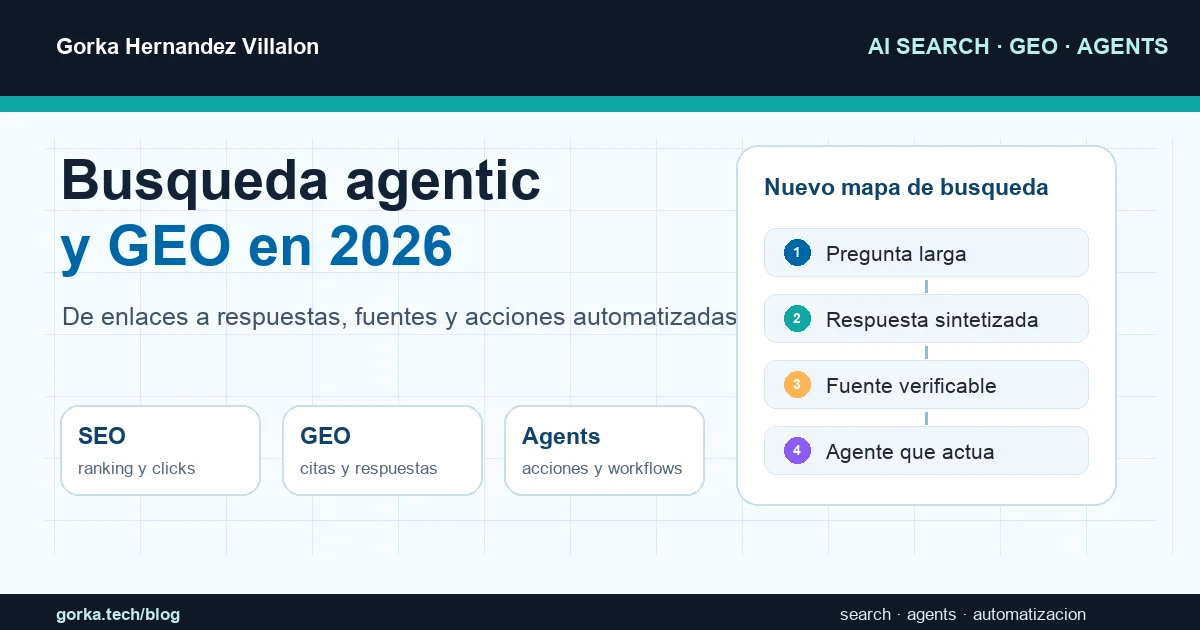
Search is changing again. For years, search optimisation meant getting a page to appear in a list of links. In 2026, that list is starting to coexist with something different: generated answers, agents that search on your behalf, summaries that compare sources and systems that do not only retrieve information but try to execute a task.
This trend is visible across several recent moves. Google introduced more AI and agent capabilities for Search at Search I/O 2026. OpenAI is pushing workspace agents in ChatGPT for repeatable workflows. Anthropic released Claude Sonnet 5, described as its most agentic Sonnet model so far. Even in ecommerce, companies such as Lantern are moving toward GEO, AEO and LLM result visibility, according to Business Insider.
To me, the important point is not that "SEO is dead". That sentence comes back every couple of years and rarely helps. What is happening is more interesting: technical SEO, verifiable content, structured data and automation are becoming parts of the same visibility system.
Direct Answer
Agentic search in 2026 forces us to think beyond classic ranking. A portfolio, brand or technical
project should not only rank a URL: it should be easy for generative engines and AI agents to
understand, cite, compare and use. That means clear content, structured data, verifiable sources,
internal architecture, llms.txt, schema, clean sitemap and pages that answer concrete questions.
| Before | Now |
|---|---|
| Search a keyword | Ask a long task or question |
| Choose a link | Read a generated answer |
| Optimise titles and backlinks | Optimise entity, evidence and structure |
| Measure positions | Measure mentions, citations, traffic and assisted conversion |
| Publish isolated content | Build your own knowledge graph |
| Chatbot as an add-on | Agents connected to real workflows |
The question is no longer only "where do I rank?". It also becomes: "when a model explains my field, project or profile, does it understand correctly who I am and why I am relevant?".
1. From Retrieving Information to Delegating Work
The main shift is that search is moving from information to action.
In classic search, the user typed something, reviewed results, compared links and made a decision. In agentic search, the user can ask:
- compare these options;
- notify me when something relevant appears;
- find the best alternative according to my criteria;
- summarise the most reliable sources;
- prepare the next action;
- generate a table;
- fill part of a workflow.
This fits the direction of workplace agents. An agent is no longer just a conversation: it can query tools, read documents, execute steps and produce reusable outputs.
In my case, this connects directly with what I have written about in OSINT with LLMs and verifiable evidence and reliable AI automations in production. If an agent is going to search or act, it needs traces, sources and limits.
2. What This Means for GEO
GEO, or Generative Engine Optimization, is not about putting more keywords inside a page. It is about preparing a website so an AI engine can understand it and cite it correctly.
A generative engine needs to answer questions such as:
- who the entity is;
- what it does;
- what experience proves it;
- which projects are verifiable;
- which sources support each claim;
- which pages are canonical;
- how projects, technologies and results relate;
- how to contact or verify the information.
For a technical portfolio, this is essential. It is not enough to say "I build AI". You need pages that explain real systems, articles that show technical judgment and data that can be checked: App Store, GitHub, external articles, repositories, videos, certificates or concrete results.
That is why it makes sense to maintain:
- clean
sitemap.xml; - correct
robots.txt; - consistent canonicals;
Person,WebSite,BlogPostingand project schema;llms.txtwith direct context;- blog posts with clear answers;
- internal links between profile, projects and articles;
- Spanish and English content when the audience justifies it.
This does not guarantee appearing in every AI answer, but it removes a lot of friction for models trying to understand the site.
3. SEO Does Not Disappear, It Becomes More Structural
Traditional SEO still matters: performance, indexability, titles, meta descriptions, internal links, useful content and external authority. The difference is that these elements now feed something broader.
A well-written article can rank in Google, but it can also serve as a source for:
- AI Overviews;
- ChatGPT Search;
- Perplexity;
- Gemini;
- Claude with web search;
- internal enterprise agents;
- candidate and portfolio summarisation workflows;
- systems that compare technical profiles.
Content needs to be more explicit. A sentence such as "I worked on interesting projects" does not help much. An AI needs something like:
Gorka Hernandez Villalon built a LinkedIn job scraping system with Python and Selenium that collected
around 10,000 job postings in 3 hours. He then used n8n and LLMs to compare role-CV fit and rank
opportunities based on ATS patterns.
That is easier to summarise, verify and connect with professional searches.
4. Impact for Technical Portfolios
A portfolio in 2026 should not be only a beautiful card. It should work as a professional identity graph.
| Element | Function |
|---|---|
| Home | Fast answer about who you are and what you do |
| About | Professional context, studies, experience and stack |
| Projects | Verifiable evidence of real work |
| Blog | Technical judgment and depth |
| Contact | Professional conversion |
| llms.txt | Direct context for generative search engines |
| Schema | Machine-readable data |
For my portfolio, long articles make sense because they explain topics that a project card cannot cover in depth: n8n architecture, FastAPI, OSINT, agent evaluation, human-in-the-loop, technical SEO, dashboards or automation in regulated environments.
A recruiter can read them. But so can an AI engine trying to answer: "who has practical experience with agents, automation and data workflows in Barcelona?".
5. Impact for Brands and Ecommerce
In ecommerce, the shift may be even stronger. If a user asks an agent:
Find summer sneakers that are comfortable, under 100 euros,
durable and backed by reliable reviews.
The agent does not need to show ten blue links. It can compare products, summarise reviews, discard options and recommend a decision.
That means a brand needs data that agents can understand:
- clear product name;
- category and attributes;
- price and availability;
- optimised images;
- sizes or variants;
- shipping and return policies;
- verifiable reviews;
- honest comparisons;
- FAQ by use case;
- content that explains real differences, not just marketing.
The Business Insider article about Lantern is interesting because it shows that some startups are already selling tools to predict how products appear in LLM queries. It is not only about ranking a page, but about appearing as a reasonable option inside a generated answer.
6. What I Would Do in a Practical GEO Strategy
If I had to optimise a portfolio or brand for agentic search, I would start with a simple audit:
| Question | Review |
|---|---|
| Is the entity clear? | name, role, location, specialisation |
| Is there external proof? | App Store, GitHub, articles, LinkedIn |
| Does the content answer questions? | direct sections, FAQs, examples |
| Is there structured data? | JSON-LD, schema, canonicals |
| Is crawlability clean? | sitemap, robots, RSS, llms.txt |
| Is there topical authority? | deep and connected articles |
| Is there an English version? | if the audience justifies it |
| Is conversion clear? | contact, CV, LinkedIn |
Then I would build a simple dashboard:
- target queries;
- candidate pages;
- Google visibility;
- AI engine visibility;
- correct or incorrect mentions;
- cited links;
- conversions;
- pages that need reinforcement.
This connects with from scattered data to useful dashboards: GEO also needs measurement, not only intuition.
7. Automating Without Creating Content Waste
The temptation will be to automate hundreds of AI-generated articles. It can work briefly, but it is fragile. Generative engines need trust. If a website publishes generic, repetitive and unsupported content, it may fill pages but not build real authority.
I would separate automation from judgment:
- AI for researching sources;
- AI for detecting content gaps;
- AI for proposing structures;
- AI for turning notes into drafts;
- human judgment for examples and verification;
- validators for links, dates and claims;
- SEO/GEO audits to check results.
Good automation does not replace judgment. It scales it.
8. Risks of the New Search Landscape
Agentic search also creates problems:
- a model can summarise a brand incorrectly;
- it can cite an outdated page;
- it can mix sources;
- it may not show the original link;
- it can execute actions on incomplete data;
- it can favour entities with stronger external presence;
- it can penalise ambiguous or unverifiable content;
- it can make conversion attribution harder.
That is why I think the future of technical SEO is not less technical. It is more technical. It will require understanding HTML, structured data, performance, analytics, APIs, logs, content and agents.
9. My Reading as a Developer
This shift interests me because it combines several areas I am already working on:
- n8n automation;
- agents with LLMs;
- OSINT with web search;
- dashboards and SQL;
- technical SEO and GEO;
- portfolios as data products;
- human review loops;
- traces, evaluation and observability.
Building for agentic search is similar to building a good AI system: clear input, reliable context, connected tools, structured output, evaluation and continuous improvement.
The difference is that now the "user" can also be an agent reading your website to decide whether to cite you, recommend your project or understand your profile.
Conclusion
Agentic search does not eliminate SEO. It pushes it toward a more demanding version: clearer, more structured, more verifiable and more connected to real systems.
For a technical portfolio, this is an opportunity. If your projects, articles, data and sources are well organised, you are not only helping Google. You are helping any AI engine understand who you are, what you have built and why it can trust that information.
In 2026, ranking is no longer only about appearing. It is also about becoming a source an agent can use without getting confused.