
Applied AI strategy: from idea to roadmap with real use cases
A practical guide to prioritising AI use cases, defining roadmaps, building MVPs, measuring impact and avoiding demos with no business value.
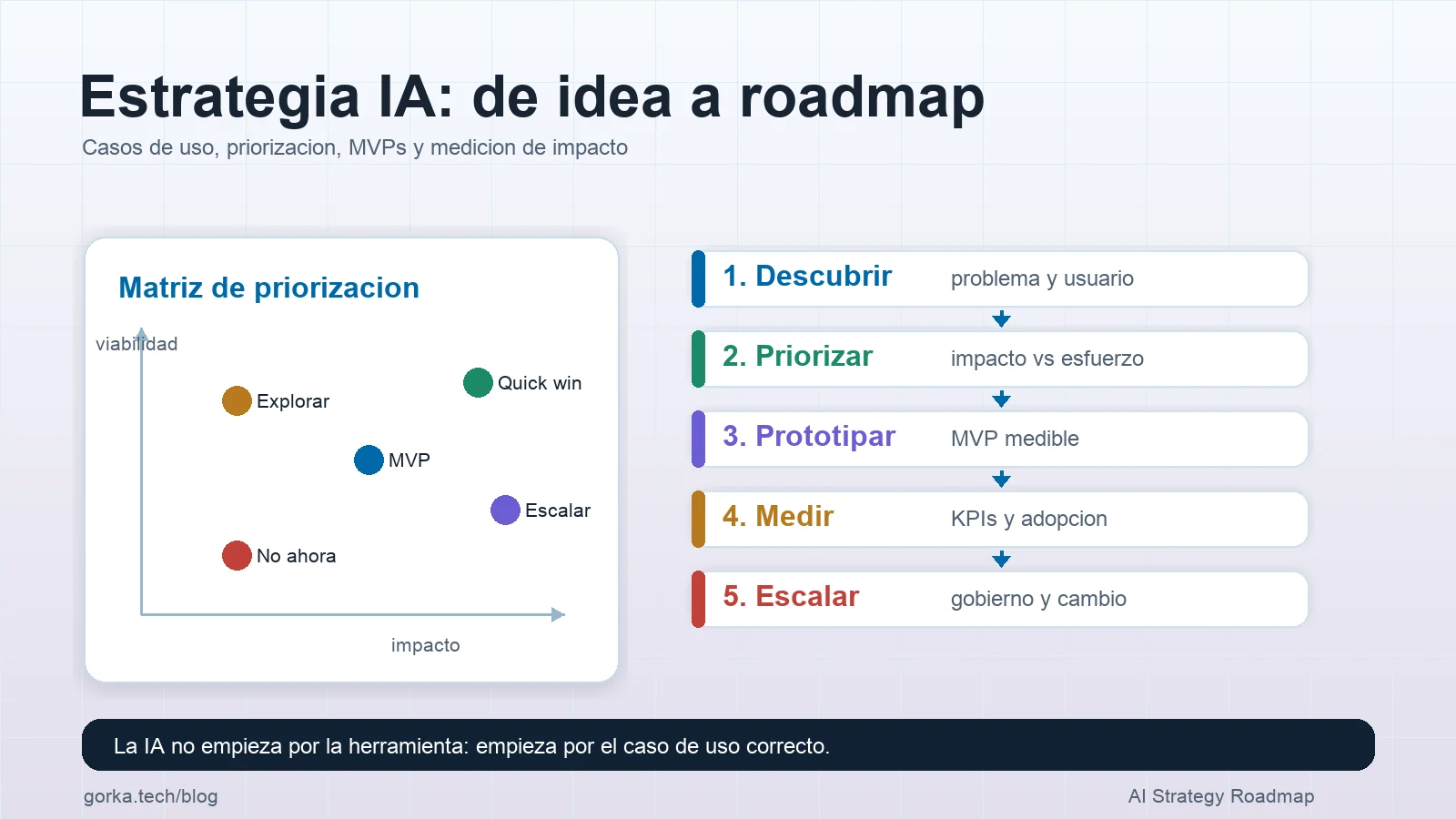
Many artificial intelligence initiatives fail before anything is built. They do not fail because a better model is missing. They fail because the use case was not chosen well.
A demo can impress in a meeting: a chatbot answers, an agent executes an action, a workflow summarises documents or a dashboard generates insights. But a company does not only need demos. It needs to know where AI reduces cost, improves speed, increases quality, supports sales, reduces risk or unlocks a new capability.
Applied AI strategy means turning technical possibilities into business decisions. For me, the right order is: problem, use case, impact, feasibility, MVP, measurement and scaling.
Direct answer
To build a useful AI strategy, you need to identify business problems, turn them into concrete use cases, prioritise them by impact and feasibility, define a measurable MVP, test it with real users, measure results and decide whether to scale, fix or discard it.
| Phase | Key question | Output |
|---|---|---|
| Discovery | Which problem deserves attention | Opportunity map |
| Prioritisation | Where impact and feasibility meet | Use case backlog |
| Design | What is the smallest useful solution | MVP and scope |
| Activation | Which tool or architecture fits | Functional prototype |
| Measurement | What change proves value | KPIs and impact |
| Scaling | What is needed for production | Roadmap and governance |
Technology matters, but it should not be the starting point. Starting with "let's use agents" is less powerful than starting with "this process consumes 20 hours per week and creates repeated errors".
1. Separate opportunity, idea and use case
Not everything that sounds interesting is a use case.
| Level | Example | Problem |
|---|---|---|
| Opportunity | Improve customer service | Too broad |
| Idea | Create an AI chatbot | Still solution-centred |
| Use case | Classify repetitive tickets and propose a response with human review | Concrete and measurable |
A good use case should have:
- affected user or team;
- current problem;
- data input;
- expected decision or action;
- connected tool or process;
- success metric;
- risks and limits.
If any of these elements is missing, we are probably still dealing with an idea, not a use case ready to prioritise.
2. Map problems before proposing AI
A large part of the work is listening before designing. I would ask teams:
- which tasks they repeat every week;
- which information they search for manually;
- where data gets lost;
- which decisions are delayed because context is missing;
- which reports are always prepared from scratch;
- where errors are frequent;
- which processes depend too much on one person.
This can become an initial opportunity map:
| Area | Pain point | Possible AI | Risk |
|---|---|---|---|
| Sales | Leads are not prioritised | Scoring and automatic summary | Incomplete data |
| Support | Repetitive tickets | Classification and suggested response | Incorrect answers |
| Operations | Manual reports | Extraction and dashboard | Inconsistent sources |
| HR | CVs are hard to compare | Assisted screening | Bias and explainability |
| Management | Many external sources | OSINT with evidence | Weak sources |
Here AI is not presented as magic. It is presented as a possible tool inside a concrete process.
3. Prioritise with impact and feasibility
A simple matrix helps a lot:
| Impact | Feasibility | Decision |
|---|---|---|
| High | High | Quick win |
| High | Medium | Priority MVP |
| High | Low | Explore or prepare foundations |
| Low | High | Automate only if it removes workload |
| Low | Low | Do not prioritise |
To estimate impact, I would look at:
- hours saved;
- cost avoided;
- quality improvement or error reduction;
- response speed;
- customer or employee satisfaction;
- sales or conversion improvement;
- operational risk reduction.
To estimate feasibility:
- data availability;
- data quality;
- required integrations;
- technical complexity;
- permissions and privacy;
- third-party dependency;
- adoption by the team.
This avoids building what looks most impressive instead of what is most useful.
4. Define the minimum MVP that proves value
An AI MVP should not try to solve everything. It should test the main hypothesis.
Example:
Hypothesis:
If an agent summarises repetitive tickets and proposes a response,
the team reduces average first-response time by 30%
without increasing complaints or errors.
The MVP could include:
- a limited set of categories;
- one input channel;
- structured output;
- mandatory human review;
- decision traces;
- results dashboard;
- team feedback.
It is not necessary to start with full autonomy. In many cases it is better to start with assistance: AI prepares, a person validates and the system learns from corrections.
This connects with human-in-the-loop for AI agents.
5. Choose architecture based on risk
Not every MVP needs the same architecture.
| Case | Reasonable architecture |
|---|---|
| Internal summary with no external action | LLM + light validation |
| Workflow across tools | n8n + APIs + logs |
| Data extraction and transformation | Python + SQL + dashboard |
| Agent that executes actions | Orchestration + permissions + state |
| Critical or regulated process | Tested service + audit + human review |
For prototypes, low-code and n8n make it possible to move fast. For reusable logic, stronger validation or critical processes, I prefer separating services in Python/FastAPI or a more structured backend.
I explain this in n8n, FastAPI and Spring for AI automation.
The important point is that architecture should respond to the risk of the use case, not to enthusiasm for a specific tool.
6. Measure impact from the first pilot
A pilot without measurement becomes an opinion. Before building, I would define a baseline:
- current process time;
- monthly volume;
- error rate;
- approximate cost;
- user satisfaction;
- number of escalations;
- perceived output quality.
Then I would compare the pilot:
| KPI | Before | After | Decision |
|---|---|---|---|
| Average time | 12 min | 7 min | Improved |
| Errors | 8% | 5% | Improved |
| Escalations | 20% | 35% | Review criteria |
| Satisfaction | 6/10 | 8/10 | Improved |
| Cost per execution | 0 | EUR 0.08 | Acceptable if time is saved |
Not every metric has to improve at the same time. Sometimes escalations increase because the system detects uncertain cases better. The reading must be business-driven, not only technical.
7. Document learnings and decisions
In AI strategy, documentation is not bureaucracy. It is organisational memory.
For every use case, I would keep:
- original problem;
- hypothesis;
- affected users;
- data used;
- architecture;
- versioned prompt or workflow;
- before/after metrics;
- risks detected;
- user feedback;
- decision: scale, fix, pause or discard.
This prevents the same debates from repeating and makes the roadmap increasingly realistic. It also helps technical teams, business teams and leadership discuss the same object.
8. Build the roadmap
An AI roadmap should not be a list of tools. It should be a sequence of capabilities.
Example:
| Horizon | Objective | Cases |
|---|---|---|
| 0-30 days | Quick wins and diagnosis | Summaries, classification, simple dashboards |
| 30-90 days | MVPs with real users | Assisted agents, internal automations |
| 90-180 days | Controlled scaling | Integrations, permissions, observability |
| 180+ days | Governance and platform | Standards, reuse, continuous evaluation |
The question is not "how many agents do we have". The question is which new capabilities the organisation has: deciding faster, responding better, reducing repetitive work, operating with more traceability or detecting opportunities earlier.
Checklist for evaluating an AI use case
- The problem is defined in business language.
- The affected user is identified.
- Data is sufficient and accessible.
- A success metric exists.
- The current process has a baseline.
- Risk is classified.
- The solution can be tested with a small MVP.
- Human review exists if the decision is sensitive.
- Cost per execution makes sense.
- Team adoption is considered.
- There is a plan to scale or discard.
Conclusion
AI strategy is not about chasing every new trend. It is about choosing where AI can create real value.
A good roadmap connects business, data, technology and people. It starts with concrete problems, prioritises with criteria, prototypes quickly, measures impact and scales only what proves value.
For me, applied AI comes down to this: fewer isolated demos, more measurable use cases. That is where technology stops being a trend and starts transforming how people work.